A bedroom without adequate storage is like a toolbox without compartments, everything ends up in a jumbled pile. A well-chosen storage dresser does more than hold clothes: it anchors the room, reduces visual clutter, and makes morning routines smoother. Whether upgrading from a hand-me-down piece or furnishing a new space, selecting the right dresser involves more than picking a style that matches the bedspread. It requires understanding how construction quality, drawer configuration, and room dimensions work together to create functional, long-lasting bedroom storage.
Table of Contents
ToggleKey Takeaways
- A storage dresser consolidates clothing and accessories into one footprint while freeing up closet space and reducing visual bedroom clutter.
- Horizontal dressers work best in rooms with low ceilings, while tall chest dressers maximize vertical space in small bedrooms—measure your space carefully, allowing at least 36 inches of clearance in front for drawer operation.
- Solid wood dressers with dovetail joinery offer maximum durability and can be refinished multiple times, while plywood veneers resist warping better in humid climates, making construction quality essential for long-term bedroom storage.
- Tall dressers over 30 inches must be anchored to wall studs with furniture straps to prevent tip-over risks, especially in homes with children.
- Smart features like drawer dividers, varied drawer heights, soft-close mechanisms, and felt liners multiply a storage dresser’s functional capacity without increasing its footprint.
- Hardware upgrades like new knobs and handles offer the fastest visual refresh, transforming a dated dresser aesthetic in minutes for just $3–8 per pull.
Why a Storage Dresser Is Essential for Bedroom Organization
Most bedrooms lose functional floor space not from large furniture, but from piles of unhoused belongings. A properly sized dresser consolidates clothing, linens, and accessories into one footprint, freeing up closet space for items that truly need hanging.
Drawer storage beats open shelving for bedrooms because it keeps dust off fabrics and maintains a cleaner visual line. Unlike wardrobes or armoires, dressers offer easy access without door swing clearance, critical in tighter rooms where every inch of circulation space counts.
A quality dresser also serves double duty. The top surface functions as a staging area for daily essentials like wallets, keys, and charging cables, or anchors a table lamp for task lighting. When placed opposite a bed, a dresser can support a wall-mounted TV without requiring a separate media console.
From a resale perspective, built-in bedroom storage increases home value, but freestanding dressers offer flexibility for renters and homeowners alike. They move with you, adapt to different room layouts, and can transition from bedroom to hallway to guest room as needs change over decades.
Types of Storage Dressers for Every Bedroom Style
Dresser designs have evolved beyond basic box-and-drawer configurations. Understanding the differences helps match function to room layout and storage volume.
Traditional Horizontal Dressers
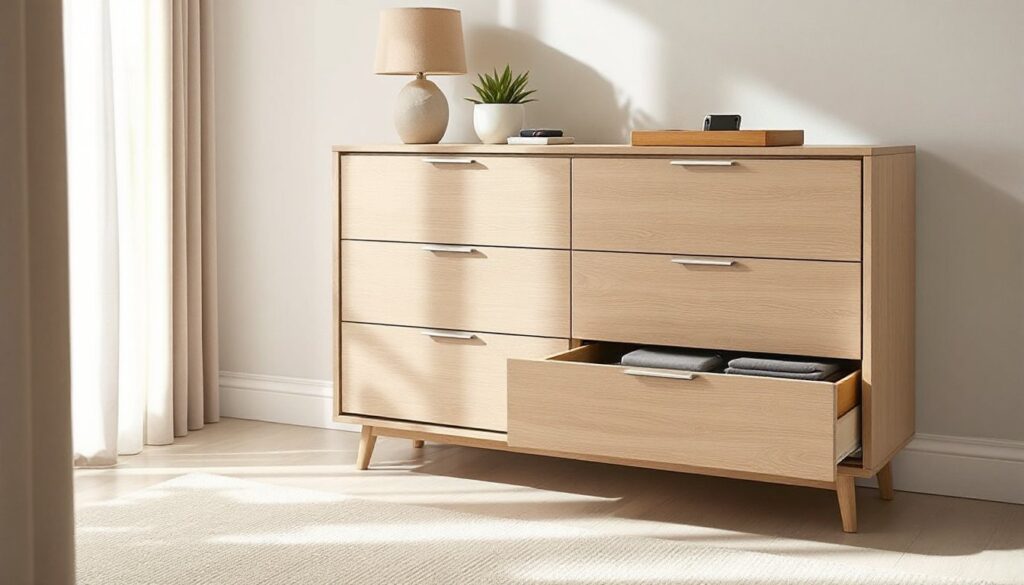
Horizontal dressers (also called double dressers or low-profile dressers) typically measure 54–72 inches wide, 30–36 inches tall, and 16–20 inches deep. They feature two vertical columns of drawers, usually six to nine drawers total.
This format works well in rooms with low ceilings or under wall-mounted art. The wide top surface accommodates mirrors, lamps, or decor without feeling cramped. They’re ideal for couples sharing a bedroom, since drawer columns can be divided by user.
Horizontal dressers require significant wall length. In a 10×12-foot bedroom, placing a 60-inch dresser leaves limited space for other furniture on that wall. Measure carefully, allowing at least 36 inches of clearance in front for drawer operation and movement, 42 inches is better if the room allows.
Tall Chest Dressers
Chest dressers (or tallboys) stand 48–60 inches tall with a narrower footprint, typically 30–40 inches wide. They contain four to six drawers stacked vertically.
These maximize vertical space in small bedrooms or for single occupants who don’t need the volume of a double dresser. They fit well in corners, alongside closet doors, or in nooks where a horizontal dresser wouldn’t clear door swings.
Safety note: Any dresser taller than 30 inches should be anchored to wall studs using furniture straps or L-brackets, per CPSC recommendations. Tall dressers present tip-over risks, especially in homes with children. Use a stud finder to locate solid anchoring points, drywall anchors alone won’t hold against lateral force.
How to Choose the Right Size Dresser for Your Space
Room dimensions alone don’t tell the full story. Successful dresser sizing balances storage volume, circulation space, and visual proportion.
Start by measuring the intended wall, accounting for baseboard trim, outlet boxes, and door swing radius. A dresser placed near a doorway needs 3–4 inches of clearance from the door’s widest arc to avoid damage and allow smooth operation.
Next, consider drawer depth. Standard drawers extend 12–14 inches when opened fully. Add this to the dresser’s depth (typically 18–20 inches) to determine total projection from the wall. In a 12-foot-deep bedroom, a 20-inch dresser with 14-inch drawer extension requires 34 inches, leaving 110 inches (about 9 feet) of remaining floor depth. That’s adequate for a queen bed (80 inches long) with walking space on both sides.
Vertical proportion matters too. In rooms with 8-foot ceilings, a 60-inch-tall chest can feel imposing. Horizontal dressers at 32–34 inches tall create better visual balance. For rooms with 9- or 10-foot ceilings, tall chests work well and draw the eye upward.
Don’t forget about getting the dresser into the room. Measure hallway widths, stairwell clearances, and doorways. Many stylish storage solutions for small spaces require disassembly for delivery, ask before purchasing if the piece ships flat-pack or fully assembled.
Material and Build Quality: What to Look For
Construction quality determines whether a dresser lasts five years or fifty. Knowing what to inspect separates solid investments from particle board disappointments.
Solid wood dressers, oak, maple, cherry, walnut, offer maximum durability and can be refinished multiple times. Joinery method matters: look for dovetail or mortise-and-tenon drawer construction rather than staples or glue alone. Dovetail joints (the interlocking finger-like cuts at drawer corners) distribute stress and resist pulling apart under weight.
Plywood and veneer dressers use a thin layer of real wood over engineered wood cores. Quality veneers over plywood offer good strength-to-weight ratios and resist warping better than solid wood in humid climates. Check edge banding (the trim covering plywood edges), it should be firmly attached without gaps or peeling.
MDF and particleboard dressers cost less but have shorter lifespans. MDF (medium-density fiberboard) handles paint finishes well and resists expansion/contraction, but both materials sag over time under heavy loads and can’t be refinished like solid wood. These work for temporary solutions or guest rooms with light use.
Inspect drawer glides closely. Ball-bearing glides with steel rollers handle heavier loads and operate smoothly for years. Cheaper plastic glides jam, wear out quickly, and limit drawer weight capacity to 15–20 pounds. Full-extension glides (which allow drawers to open completely) provide better access to items at the back.
Many DIYers build custom pieces using free plans like those from Ana White’s max storage dresser designs, which allow size customization and material selection based on budget. Building from scratch gives control over joinery quality and finish, though it requires basic carpentry skills and access to a table saw or circular saw, drill, and pocket hole jig.
Maximizing Storage With Smart Dresser Features
Beyond basic drawer boxes, certain features multiply a dresser’s functional capacity without increasing its footprint.
Drawer dividers, either built-in or aftermarket, prevent clothing from becoming a tangled mess. Cedar dividers add moth-repellent properties for wool and cashmere storage. Spring-loaded adjustable dividers let you reconfigure compartments as storage needs change.
Varied drawer heights improve organization. Shallow top drawers (4–5 inches tall) suit accessories, undergarments, and jewelry. Mid-height drawers (7–9 inches) work for folded shirts and pants. Deep bottom drawers (10–12 inches) accommodate bulky sweaters, linens, or out-of-season items.
Soft-close mechanisms aren’t just luxury features, they prevent slammed drawers from damaging joinery and reduce noise in shared spaces. They add $20–40 to dresser cost but extend lifespan by reducing impact stress.
Some dressers include felt-lined top drawers for delicate items or watches. If yours doesn’t, adhesive-backed felt sheets (available at any hardware store) install in minutes and cost under $10.
For rooms with awkward layouts, creative minds at IKEA Hackers demonstrate how modular furniture can be modified with added shelving, casters for mobility, or paint treatments that match existing decor. Similarly, budget-conscious renovators at Young House Love showcase dresser makeovers using contact paper, new hardware, and creative drawer liner installations that transform dated pieces.
Hardware upgrades offer the fastest visual refresh. Replacing standard knobs with bin pulls, cup pulls, or brass handles changes the entire aesthetic for $3–8 per pull. Use a template jig when drilling new holes to ensure consistent spacing, measure twice, drill once.
Finally, consider anti-tip straps mandatory, not optional. Install them to wall studs using 3-inch wood screws for dressers in any home with children or pets. The CPSC reports dozens of annual furniture tip-over deaths, most preventable with $5 worth of hardware and 10 minutes of installation time.