Closets have a way of turning into black holes, stuff goes in, but finding it again? That’s another story. Storage bins are the workhorse of closet organization, creating visible zones, protecting off-season gear, and making the most of vertical and shelf space. Whether you’re tackling a walk-in, a reach-in, or a closet the size of a shoebox, the right bins transform chaos into a system that actually holds up through daily use. This guide walks through bin types, selection criteria, and practical strategies to maximize every cubic inch of your closet.
Table of Contents
ToggleKey Takeaways
- Storage bins for closets compartmentalize items, protect contents from moisture and pests, and create visual calm while enabling you to maximize every cubic inch of vertical and shelf space.
- Plastic bins are durable and stackable for most storage needs, fabric bins offer a softer aesthetic for visible closets, and wire baskets provide airflow for items prone to mustiness—choose based on what you’re storing and your closet conditions.
- Measure your closet shelves before purchasing storage bins to avoid buying containers that are too tall or too deep, and always prioritize bins with recessed lids if stacking more than three high.
- Label all storage bins clearly and keep the most-accessed items at eye level, while reserving top shelves and high areas for long-term or seasonal storage to improve both accessibility and safety.
- Maximize closet organization by using underutilized zones like the floor under hanging clothes, installing shelf dividers to prevent toppling, and rotating seasonal bins to keep your active closet stocked with what you actually need.
Why Storage Bins Are Essential for Closet Organization
Storage bins do more than just hold stuff, they define zones, protect contents, and prevent the avalanche effect that happens when you pull one item off a shelf. Unlike open shelving, bins contain small items, keep dust and moisture off fabrics, and stack efficiently to use vertical space.
In closets, bins serve three core functions. First, they compartmentalize categories, winter accessories, craft supplies, shoes, linens, so you’re not digging through a pile. Second, they protect contents from light, pests, and humidity, which matters for wool, leather, or anything stored long-term. Third, they make use of awkward spaces: high shelves, deep corners, or the floor under hanging clothes.
Bins also create visual calm. A shelf stacked with matching containers looks intentional, even if what’s inside is a jumble of extension cords and old chargers. For renters or anyone who can’t install built-ins, bins offer a zero-commitment organizing system that moves with you.
One often-overlooked benefit: bins force decision-making. If it doesn’t fit in the bin, you either purge or reassess your storage plan. That constraint can be clarifying, especially in small closets where every square foot counts. When paired with small space strategies, bins become the backbone of a functional system.
Types of Storage Bins for Closets
Not all bins are built the same. Material, transparency, and structure each affect how well a bin works in a given closet. Here’s the breakdown.
Plastic Bins and Clear Containers
Plastic bins are the heavy lifters of closet storage, durable, stackable, and available in every dimension imaginable. Clear plastic containers let you see contents at a glance, which is clutch for bins stored on high shelves or in deep stacks. Look for bins with snap-lid closures if you’re storing items that need pest or moisture protection, or open-top bins for everyday access.
Standard sizes range from 6-quart shoe boxes (roughly 13″ × 8″ × 5″) to 66-quart underbed bins (roughly 30″ × 18″ × 6″). Measure your shelf depth and height before buying, nothing’s worse than a bin that’s a half-inch too tall to slide in.
Polypropylene is more flexible and crack-resistant than polystyrene, especially in cold garages or basements. If you’re stacking bins more than three high, choose bins with recessed lids so they nest securely. Some bins come with label windows or clip-on tags, which beat trying to scribble on curved plastic with a Sharpie.
Clear bins work best for items you need to locate quickly, shoes, seasonal clothes, or craft supplies. For anything you’d rather not display (old tax documents, random cables), opaque bins or bin liners keep it out of sight.
Fabric and Canvas Storage Bins
Fabric bins bring a softer look and lighter weight, making them easier to pull down from high shelves. Canvas, cotton, or polyester blends are common: some have wire or cardboard frames to hold their shape, while others collapse flat when empty.
These bins excel in closets where aesthetics matter, linen closets, nurseries, or any space visible from the bedroom. They’re also gentler on delicate items like knitwear or scarves. Look for bins with reinforced handles if you’ll be lifting them regularly, and check whether they’re machine-washable (most are, but some inserts aren’t).
Fabric bins don’t stack as reliably as rigid plastic, so they’re better suited for cubbies, shelves, or the floor. Many come in modular sizes designed to fit standard cube organizers (like 11″ or 13″ cubes). If you’re retrofitting a closet with wire shelving, fabric bins prevent small items from falling through the gaps.
Downside: fabric offers zero moisture or pest protection. Don’t use these for wool, leather, or anything stored in a damp basement. And if you have kids or pets, light-colored fabric shows dirt fast.
Wire and Metal Baskets
Wire baskets offer visibility and airflow, making them ideal for items that benefit from ventilation, gym clothes, shoes, or anything that tends to get musty in a sealed bin. They’re also the go-to for pull-out closet systems, where baskets slide on rails or sit on shelves.
Coated wire (vinyl or powder-coated steel) resists rust and won’t snag fabrics. Bare metal baskets look industrial but can leave marks on wood shelves or scratch delicate items. Basket depth matters: shallow baskets (4″–6″ deep) work for accessories or folded tees, while deeper baskets (10″+ deep) handle bulkier items like blankets or handbags.
Wire baskets don’t contain small items well, think loose socks, jewelry, or screws, so pair them with fabric liners or use them for larger, grouped items. They’re also heavier than plastic or fabric, which can be a plus (they won’t tip) or a minus (harder to move around).
Many closet organization systems incorporate wire baskets as slide-out drawers, especially in custom or modular setups. If you’re building your own, make sure the basket width matches the shelf or rail dimensions, most are sized in 12″, 16″, or 24″ widths.
How to Choose the Right Storage Bins for Your Closet
Choosing bins isn’t about grabbing the prettiest option at the store, it’s about matching bin type to closet layout, contents, and access frequency.
Start with measurements. Measure shelf depth, width, and height (including clearance to the next shelf). Standard closet shelves are 12″ deep, but custom built-ins or wire shelving can vary. A bin that’s 13″ deep won’t slide onto a 12″ shelf, and a bin that’s 14″ tall won’t fit under a shelf that’s 14.5″ high with no wiggle room.
Consider what you’re storing. Heavy items (books, tools) need rigid bins with sturdy bottoms, cheap plastic will bow. Delicate fabrics do better in fabric bins or plastic bins with smooth interiors (no rough seams). Items you access weekly should go in open-top or easy-flip-lid bins: long-term storage can use latched or sealed bins.
Match bin type to closet conditions. In a climate-controlled bedroom closet, fabric bins are fine. In a garage, attic, or basement, use plastic with sealed lids to keep out moisture, pests, and temperature swings. If your closet has wire shelving, use bins with flat bottoms so they don’t sag through the gaps.
Think about stackability. If you’re stacking, bins with recessed lids or interlocking features prevent toppling. Avoid mixing bin sizes in a stack, different footprints make the whole column unstable. For bins on high shelves, prioritize lightweight materials and built-in handles.
Label everything. Even clear bins benefit from labels, especially if contents shift or you’re storing similar-looking items. Use a label maker, chalkboard labels, or painter’s tape and a marker. Place labels on the front and the end so you can ID bins from multiple angles.
Color-code if it helps. Some people swear by color-coding, blue bins for winter, green for summer, gray for electronics. Others find it adds unnecessary complexity. Test it with a small zone before committing to a full rainbow.
Buy a few extras. Bins multiply as you organize, you’ll find more stuff that needs a home. Having a couple of spare bins on hand prevents mid-project runs to the store. Just don’t go overboard: buying 30 bins for a closet that holds 15 is a waste of money and space.
Creative Ways to Maximize Closet Space with Storage Bins
Bins aren’t just for shelves, here’s how to squeeze more function out of every closet zone.
Use vertical space aggressively. Stack bins floor to ceiling, but keep the most-accessed items at eye level or below. Top shelves are for long-term storage (holiday decor, off-season clothes). Use a step stool or folding ladder if your closet ceiling is above 8 feet, don’t risk shoulder injuries reaching for a bin.
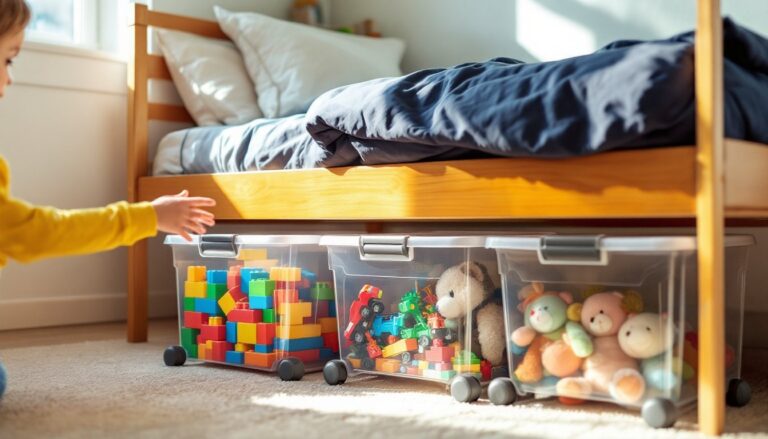
Exploit underutilized zones. The floor under hanging clothes is often wasted. Slide low-profile bins (6″–8″ tall) underneath for shoes, bags, or gym gear. If you have a double-hang closet rod, bins on the floor of the lower section keep that space from becoming a junk magnet.
Install shelf dividers or risers. Shelf dividers prevent bin stacks from toppling sideways. Wire or acrylic shelf risers create a second tier on deep shelves, effectively doubling usable space. This works especially well for smaller bins, stack purses or hats on the riser, bins below.
Mount bins on the back of the door. Over-the-door organizers aren’t just for shoes. Hang fabric bins or wire baskets on a door-mounted rack for accessories, cleaning supplies, or overflow from overstuffed shelves. Make sure the door clears the rack when it swings, measure door thickness and hinge offset.
Turn bins into drawer inserts. If your closet has built-in drawers, use small bins as dividers for socks, underwear, or jewelry. This is a budget-friendly alternative to custom drawer organizers. Measure drawer interior dimensions first: most dresser drawers are 12″–16″ wide.
Create a drop zone. Place an open-top bin near the closet entrance for daily-use items, tomorrow’s outfit, a gym bag, keys. This keeps counters and chairs from becoming clothes piles. Fabric bins work well here since they won’t scratch floors or make noise when you toss stuff in.
Use bins as building blocks for modular systems. Cube organizers, shelf units, or DIY frameworks turn bins into custom storage without permanent installation. This is ideal for renters or anyone who reorganizes seasonally. Many bins are sized to fit standard cube dimensions (11″, 13″, or 15″ square).
Rotate seasonally. Swap bins in and out as seasons change. Store winter bins on high shelves or in a garage during summer: bring them down when temperatures drop. This keeps your active closet stocked with what you actually need, not buried under three layers of off-season gear.
Group by frequency, not just category. Don’t just bin by type, think about how often you use items. Daily items go in easy-access bins at waist height. Weekly items can go higher or lower. Monthly or seasonal items belong in the back or on top shelves. This is especially useful in small apartments where every bin shift counts.
Safety note: If you’re stacking bins higher than shoulder level or loading bins with heavy items (more than 20–30 lbs), make sure shelves are properly anchored to wall studs, especially in seismic zones or homes with kids. Wire shelving has weight limits, check manufacturer specs before loading it up. And always put heavier bins on lower shelves to keep the center of gravity low.